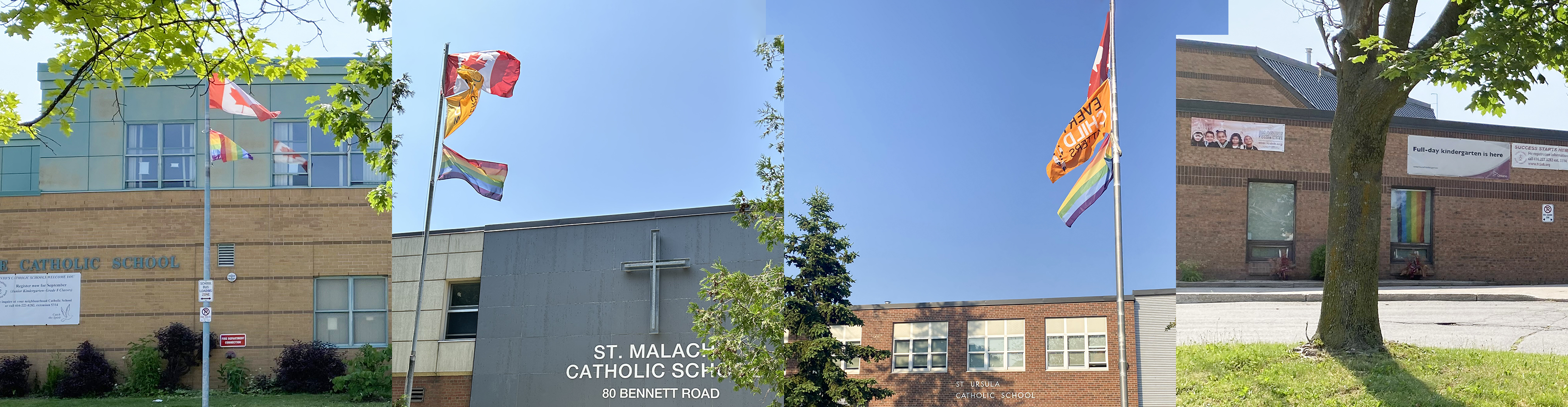

Collage of four photo of TCDSB schools with the pride flag flown outside of them, in addition to the Canada Flag

2SLGBTQ+ Inclusion

2SLGBTQ+ inclusion is one of the three braided strands in the Toronto Catholic District School Board (TCDSB) 2023-2026 Equity Action Plan.

With our belief in the worth and dignity of every person, we demonstrate living out the Gospel values of love, inclusion, compassion, and care for all. As affirmed by Scripture, human beings are created in the image and likeness of God, each with inimitable characteristics deserving of dignity. As such, the TCDSB endeavours to create welcoming and safe learning environments, with appropriate resources, which support and recognize the uniqueness of individuals and the broader Catholic community.

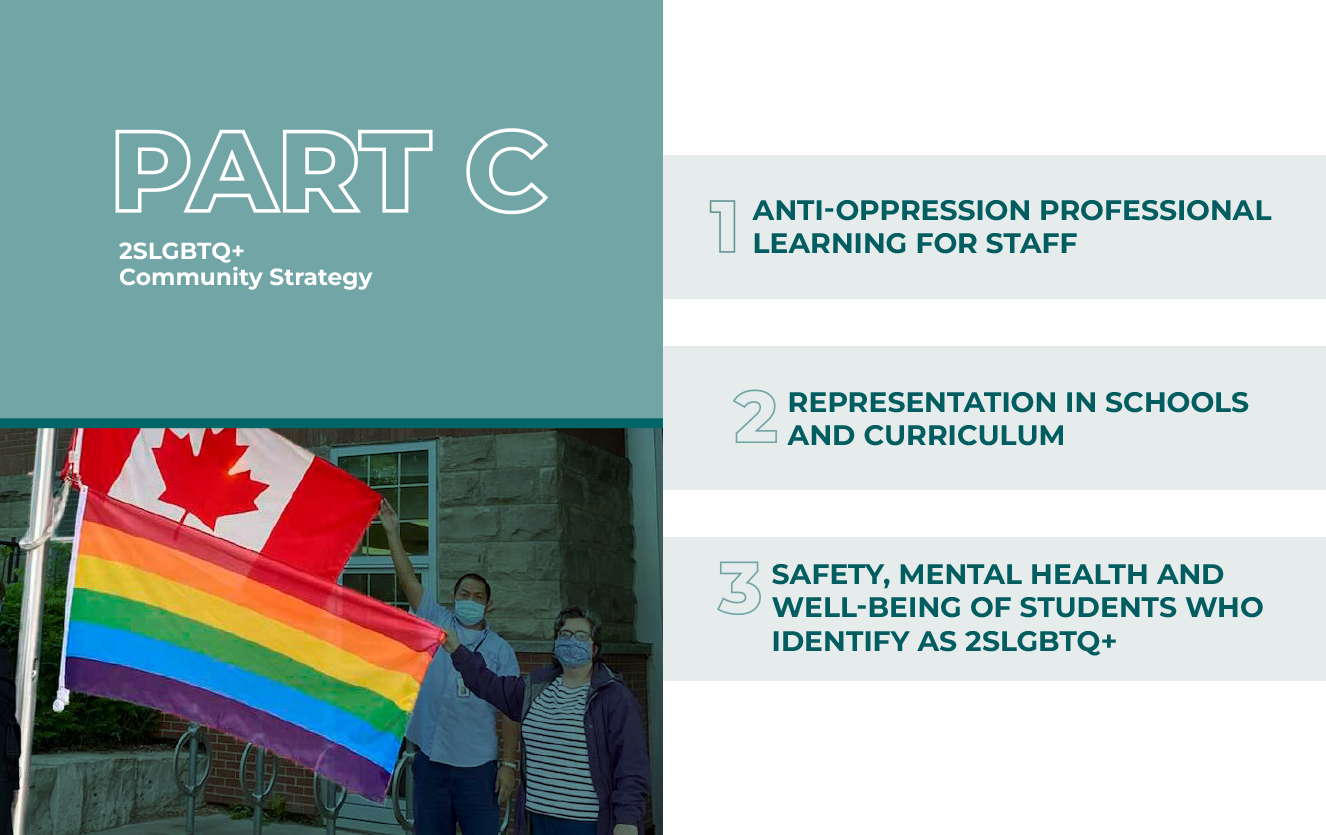
Our 2SLGBTQ+ Community Strategy includes the following areas of focus:

  1. Anti-oppression professional learning for staff: We will continue to provide professional learning regarding anti-oppression (AO), discrimination and bias, as well as how to support 2SLGBTQ+ staff and students.

  2. Representation in schools and curriculum: Throughout K-12, we will continue to ensure that the curriculum meaningfully includes 2SLGBTQ+ experiences.

  3. Safety, mental health and wellbeing of students who identify as 2SLGBTQ+: We will provide a safe and mentally healthy school climate that supports students.

2SLGBTQ+ Community Strategy 1. Anti-oppression professional learning for staff. 2. Representation in schools and curriculum. 3. Safety, mental health and wellbeing of students who identify as 2SLGBTQ+.

Why 2SLGBTQ+ inclusion? Because TCDSB C.A.R.E.S.

The following are five core reasons for 2SLGBTQ+ inclusion at the Toronto Catholic District School Board:

Catholic, Aligned with Curriculum, Rights, Equity Action Plan, Student Mental Health & Wellbeing

Family Resources

These resources provide support to parents/families of all children at the TCDSB, especially those who are 2SLGBTQIA+. Creating an environment of inclusion and acceptance benefits all children.

The Family Acceptance Project

We highlight the work of Dr. Caitlyn M. Ryan out of San Francisco State University as it provides a great starting point for families of LGBTQ children in a way that is sensitive to the context of families, cultures, and faith communities.

How do we ensure that TCDSB schools are safe for all students, especially those who are 2SLGBTQ+?

Where can I get more support?

Faith Communities and 2SLGBTQIA+ Youth

Often, belonging as a 2SLGBTQIA+ person is held in tension with religious identity. There are many Catholic and non-Catholic faith communities that provide understanding and affirming spaces, support, and advocacy for the inclusion of Two Spirit, Lesbian, Gay, Bisexual, Trans, Queer/Questioning, Intersex, Asexual persons plus many others who are under the 2SLGBTQIA+ umbrella. Below are some communities and resources that centre the 2SLGBTQIA+ community.

Starting point: “Religious literacy” includes “understanding the internal diversity within religious, spiritual, and secular worldviews and groups”. Learn more at Centre for Civic Religious Literacy in Canada.

Listening as a Fundamental Posture

Pope Leo has emphasized listening not as a methodological tool or strategy, but as a fundamental posture. Formation begins not with ready-made answers, but with encounter, dialogue, and attentiveness to the realities people bring with them. He offers us an invitation to accompany with greater care and humility. The letter resonates strongly with Pope Francis’ pastoral emphasis on putting people before ideas, grounding ministry in mercy, and attending to reality rather than abstraction. An educational approach shaped by listening resists reducing learners to outcomes, metrics, or problems in need of resolution


   Institute for Catholic Education Monograph: Drawing New Maps of Hope - A Reflection for Catholic Education in Ontario

Listening as Unlearning

Here are some resources to help grow understanding of 2SLGBTQIA+ peoples. Often, fears and threats are grounded in misinformation so listening with curiousity is a helpful starting point.

Human Rights and Safety

While understanding or defining sex and gender as separate and distinct terms is not consistent with the teaching of the Catholic Church, and does not reflect a Catholic understanding of the human person and the nature of sexuality, it is a perspective that is recognized in law (OHRC), and should be acknowledged.


   Institute for Catholic Education (ICE) Monograph Fall 2019

"Members of the community are encouraged to develop personal maturity by overcoming fear of or discomfort with persons who identify as transgender."


   ICE Monograph Fall 2019

Charity must always be shown in discussions where different viewpoints may arise. To be truly Catholic is to respect diversity.


   Page 25, ICEON.CA, Grade 9/10

Engaging Students

Affinity groups aim to bring people with shared identities together to explore education, advocacy, and solidarity. They can help create communities where individuals feel affirmed, connected, supported and comfortable showing up in their most authentic way.


DID YOU KNOW?

2SLGBTQIA+ Inclusion in Schools Improves Conditions for Straight Students

Canadian research in 2014 shows that GSAs and anti-bullying policies lowered odds of suicidal thoughts for straight boys by 27% (compared to schools with no GSA or policies in place). For lesbian, gay, and bisexual students, the odds of homophobic discrimination and suicidal thoughts dropped by more than half in long-standing schools with GSAs.

(Source: Saewyc et al. (2014))